
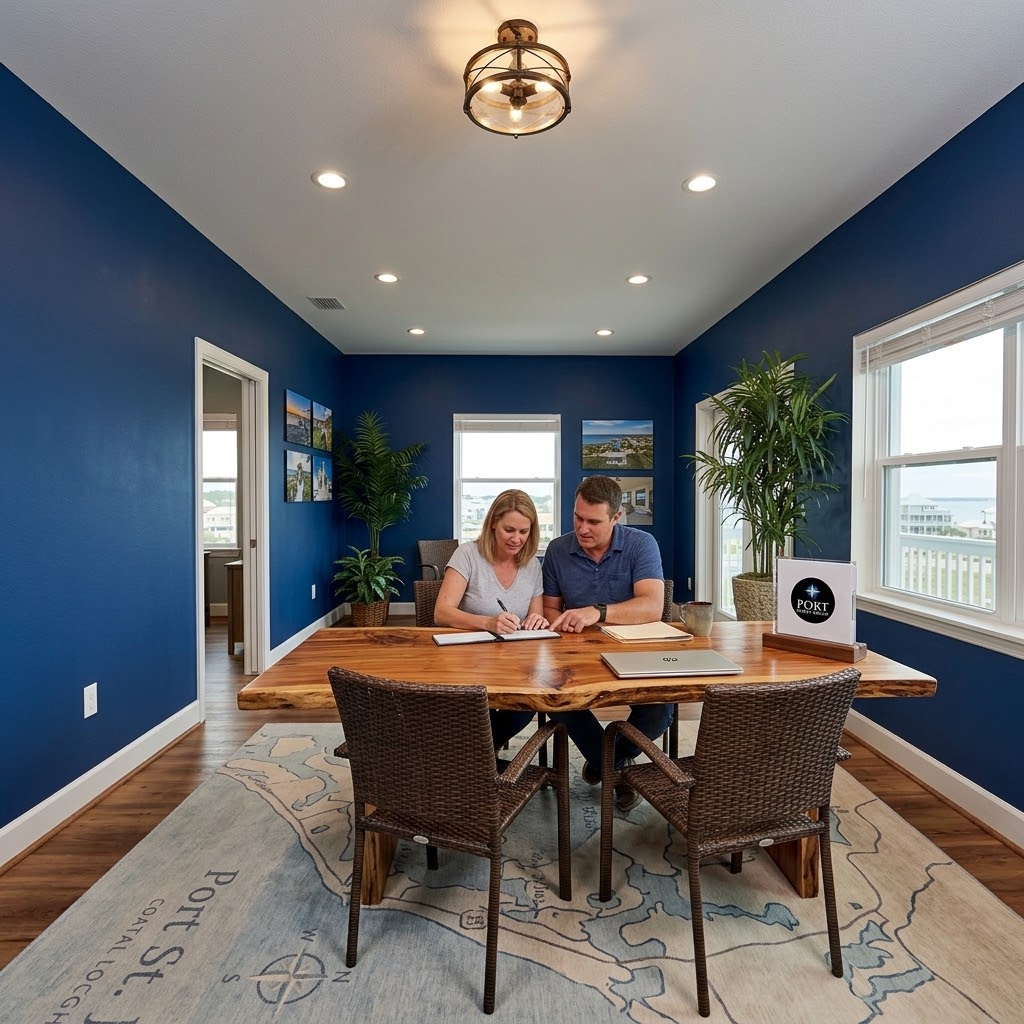
How much earnest money do you need to buy a home on Florida's Forgotten Coast?
Most buyers here put up 1 to 3 percent of the purchase price as an initial escrow deposit, and on a second home in the $500,000 to $2.5 million range a round figure like $10,000 or $25,000 is common. Under the Florida Realtors and Florida Bar AS IS contract, the initial deposit is due within 3 days after the effective date when that blank is left blank, and it comes back to you in full if you cancel in writing before the inspection period expires. The deposit is not a fee and it is not the seller's money. It is your own funds, held by a neutral escrow agent and credited to you at closing.
By Billy Joe Smiley | October 15, 2026
A buyer called me last month, an hour before she signed an offer on a house near Port St. Joe, and asked whether she was about to wire twenty five thousand dollars to a stranger she might never see again. Fair question. The money moves early, it moves before the inspector ever walks the property, and nobody sits people down and explains the mechanics.
So here is the short version, and it is better news than most people expect. Your escrow deposit is your money. It sits with a neutral third party, it gets credited back to you on the closing statement, and in a normal transaction on this coast you get every dollar returned if you decide inside the inspection window that the house is not the one. Once the timing makes sense to you, the deposit stops being something to fear and becomes something you can use.
Where the money actually goes
Nearly every residential deal in Gulf, Franklin, and Bay counties runs on the AS IS Residential Contract for Sale and Purchase published jointly by Florida Realtors and The Florida Bar. Paragraph 2 of that contract names an Escrow Agent, and on the Forgotten Coast that is almost always the title company or the closing attorney handling the transaction. It is not the listing brokerage, and it is not the seller.
Paragraph 13 spells out what that escrow agent may and may not do. The agent deposits the funds promptly, holds them in escrow inside the State of Florida, and disburses them only according to the terms of the contract. If a licensed real estate broker is holding the deposit instead, that broker has to follow Chapter 475 of the Florida Statutes and the Florida Real Estate Commission's rules for resolving any dispute. Either way, the money is not sitting in anybody's operating account waiting to be spent.
On the day you close, the deposit shows up on your settlement statement as a credit against what you owe. It reduces your wire at the table dollar for dollar. It was never an extra cost, and understanding what a buyer actually pays in closing costs on the Forgotten Coast makes that easier to see, because the deposit is the one line on that page that is already yours.
How much to put up on a coastal second home
Florida has no statutory minimum or maximum. The number is negotiated, and it goes in the blank on page one. Around the state, 1 to 3 percent of the purchase price is the ordinary range. In second home and vacation markets like ours, people tend to write round numbers rather than percentages, so on a $750,000 house on Cape San Blas I commonly see $15,000 or $25,000 rather than $22,500.
What that number communicates matters more than its size. A seller reading two similar offers reads the deposit as a measure of how serious you are and how likely you are to actually close. A strong deposit can win you a house without costing you a dollar more in price. That said, we are in a market where buyers on the Forgotten Coast have real negotiating leverage right now, and you do not need to overreach to be taken seriously. I would rather write a clean, well structured offer than an oversized deposit.
There is also a structure I like for higher priced homes, and the contract is built for it. Paragraph 2(a) covers the initial deposit and Paragraph 2(b) covers an additional deposit delivered later, with a default of 10 days after the effective date when the blank is left empty. Write a moderate initial deposit, then schedule the additional deposit to land just after your inspection period closes. The seller sees a large total commitment. You keep your exposure small during the window when you are still deciding. That is the kind of thing a good listing agent respects and a good buyer's agent should be setting up for you.
The three dates that decide whether your deposit is at risk
This is the part worth committing to memory, because the contract's protections are generous as long as you act inside the windows. The figures below are the contract's fill in defaults, which apply when the corresponding blank is left blank. In practice we negotiate them, so check the numbers actually written on your own contract.
| Deadline | Contract default | What it means for your deposit |
|---|---|---|
| Initial deposit delivered | 3 days after the effective date | Send it on time. Late delivery is itself a breach. |
| Additional deposit delivered | 10 days after the effective date | Negotiable, and often better placed after the inspection period. |
| Inspection period ends | 15 days after the effective date | Cancel in writing before it expires and the full deposit is returned. |
| Loan approval period ends | 30 days after the effective date | Timely written notice that financing failed also returns the deposit. |
Two details save people real money. First, those are calendar days, not business days. Standard F of the contract says so plainly. The one mercy built in is that a deadline landing on a Saturday, a Sunday, or a national legal public holiday rolls forward to the next day that is not one of those. Second, Paragraph 12(a) gives you the right to terminate during the inspection period in your sole discretion. You do not have to prove anything is wrong with the house. You deliver written notice before the period expires, and the deposit paid is returned to you.
That inspection window is also where your real due diligence belongs, and on this coast that means more than a general home inspection. Order your wind and flood insurance quotes during that period, not after, and get the elevation certificate in hand so the quotes come back accurate. Pull the survey. Read the title commitment. If the inspection turns up items you want addressed, that is a conversation, and negotiating repairs after a home inspection on the Forgotten Coast is a normal, workable part of the process rather than a fight.
What happens if the deal comes apart
Most transactions never get here, and I want to be clear about that before I describe the machinery. In my experience the overwhelming majority of deposits either get credited at closing or come back to the buyer without drama.
Still, the contract has an answer for each direction. Under Paragraph 15(a), if a buyer walks away outside the contract's protections, the seller may elect to keep the deposit as agreed upon liquidated damages, and that election settles the matter. Under Paragraph 15(b), if the seller is the one who fails to perform, the buyer may elect to take the deposit back without giving up the right to sue for damages or to seek specific performance. The remedy is symmetrical, which is not something people expect.
If both sides claim the same money, Paragraph 13 controls. The escrow agent can keep holding the funds until the parties agree or a court decides, or deposit them with the clerk of the circuit court. When a broker holds the deposit, Florida law and FREC rules give a path through mediation, arbitration, interpleader, or an escrow disbursement order. Nobody gets to simply take the money.
One clause matters more here than in most of Florida. Standard G, the force majeure provision, names the unavailability of hazard, wind, flood, or homeowners' insurance as an event that extends the closing date. If a named storm is in the box and carriers stop binding, your timeline stretches rather than snapping. If that condition drags on more than 30 days past the closing date, either party may terminate and the deposit is refunded to the buyer. I walk through how that plays out in practice in my guide to buying a Forgotten Coast home during hurricane season.
Frequently Asked Questions
How much earnest money is normal on a Forgotten Coast home?
One to three percent of the purchase price is the ordinary range in Florida, and there is no statutory minimum or maximum. On second homes in the $500,000 to $2.5 million range here, buyers usually write a round figure such as $10,000 or $25,000 rather than an exact percentage. The amount is negotiated between you and the seller and written into Paragraph 2 of the contract.
Is my earnest money refundable in Florida?
During the inspection period it is fully refundable. Paragraph 12(a) of the AS IS contract lets you terminate in your sole discretion, for any reason, by delivering written notice to the seller before that period expires, and the deposit paid is returned to you. After that window closes, your protection depends on whichever contingencies are still active, such as financing or appraisal.
When is the deposit actually due, and is it 3 business days?
It is 3 days, not 3 business days, and that difference trips people up because it is repeated incorrectly all over the internet. The AS IS contract lets you either send the initial deposit with the offer or deliver it within a set number of days after the effective date, defaulting to 3 when the blank is left empty. Standard F specifies calendar days, with deadlines that land on a Saturday, Sunday, or national legal public holiday rolling to the next day that is not one of those.
Who holds my deposit on a Forgotten Coast purchase?
The escrow agent named in Paragraph 2 of the contract, which in this market is normally the title company or closing attorney closing the transaction. That agent must deposit the funds promptly, hold them in escrow within the State of Florida, and disburse them only as the contract directs. If a licensed broker holds the deposit instead, Chapter 475 of the Florida Statutes and FREC rules govern how any dispute gets resolved.
What happens to my deposit if the appraisal comes in low?
That depends on whether your contract carries an appraisal contingency, which is a separate provision from the general financing terms. With one in place and the deadlines met, a low appraisal you cannot resolve gives you a path to cancel and recover the deposit. Waterfront and custom homes on this coast appraise low more often than inland tract housing does, so it is worth deciding deliberately rather than by default.
The deposit is one of the few parts of a real estate transaction that is entirely in your control. You choose the number, you choose the structure, and you control whether you act inside the windows that protect it. Get those three things right and the money is never really at risk. If you are working on an offer for a place on Cape San Blas, in Port St. Joe, or over in Mexico Beach and you want a second set of eyes on the deposit terms before you sign, call or text me at (850) 340-1213. I have written these terms a thousand times and I am happy to walk you through yours line by line.
I am a real estate broker, not an attorney. This is general information about how the standard Florida contract works, not legal advice on your specific transaction. For questions about your own contract or an escrow dispute, talk with a Florida real estate attorney.
Billy Joe Smiley is one of Florida's most accomplished real estate professionals, with over 27 years of experience and more than 1,000 properties sold. As a top 1% REALTOR® based at Port Realty Group, Billy Joe serves the Forgotten Coast with unmatched insight, professionalism, and care. He works with buyers and sellers across Port St. Joe, Cape San Blas, Mexico Beach, and St. George Island, specializing in luxury and waterfront homes, investment properties and 1031 exchanges, beachfront and bayfront land, vacation homes and income-producing real estate, and real estate development and architectural planning. A Gulf County native, Billy Joe pairs deep local knowledge with decades of experience in brokerage, land development, custom home building, and architectural consulting. Recognized as The Forgotten Coast's Most Trusted Realtor, Billy Joe has earned 90+ public reviews across Zillow, Google, and Realtor.com.
Enjoy this blog post? Click here to subscribe for updates
Leave A Comment