
Your inspection found issues. Can you get the seller to fix them or pay you for it?
Yes, and in today's Forgotten Coast market you have more room to work with than buyers have had in years. Florida's standard AS IS contract does not require a seller to make repairs, but it gives you a defined inspection period, typically 10 to 15 days, to use your findings as leverage for a closing credit, a price reduction, or repairs before closing. With inventory rising across Cape San Blas and the surrounding coast, sellers are saying yes to reasonable requests more often than they were even a year ago.
By Billy Joe Smiley | August 6, 2026
The inspection report just landed in your inbox and it's longer than you expected. Maybe the roof is pushing 17 years. Maybe the inspector flagged some corrosion around the AC handler, or a WDO report came back with old termite damage nobody mentioned. Take a breath, because this is one of the most normal moments in a home purchase, and it is also one of the best opportunities you will get to improve your deal. After 27 years of walking buyers through inspections on Cape San Blas, Port St. Joe, and every stretch of coast in between, I can tell you the buyers who come out ahead are the ones who treat the inspection report as a negotiating tool, not a reason to panic.
Here is exactly how I walk my clients through it, from what Florida's contract actually allows to what is genuinely worth asking for on a coastal, elevated home.
What Florida's AS IS contract actually gives you
Almost every home sale on the Forgotten Coast runs through the FAR/BAR "AS IS" residential contract, which means the seller is not obligated to fix a single thing. That sounds like it favors the seller, but read the fine print and you will see it actually hands you a very clean tool: the right to cancel the contract and get your full earnest money deposit back, for any reason, at any time during the inspection period. That window is typically 15 calendar days by default, though many Forgotten Coast contracts negotiate it down to 10, and it counts weekends and holidays. The deadline is firm, so once it passes, you generally cannot cancel over something the inspection turned up.
That right to walk away is exactly what gives you leverage before the deadline. The seller knows you can cancel cleanly, so a reasonable, well-documented request usually gets a real conversation instead of a flat no. The goal is rarely to actually walk away. It is to use the deadline as the reason the seller engages seriously with your ask.
Credit, repair, or price cut: picking the right ask
Once you know what you want to address, you have three tools, and picking the right one matters as much as the number you land on.
- A closing cost credit. This is what I recommend most often. The seller reduces what you owe at the table, and you hire your own contractor on your own timeline after you own the home. You control the quality of the work instead of hoping the seller's guy does it right, and there is no repair to inspect and re-inspect before closing.
- Seller-completed repairs. This makes sense for something simple and verifiable, like an active WDO treatment the seller's pest control company can knock out in a week. For anything bigger, like roofing or structural work, a credit almost always serves you better.
- A straight price reduction. This lowers your loan amount rather than putting cash in your pocket at closing, which can help your monthly payment but does not hand you funds to actually do the work. Worth considering when the seller is firm on not offering a credit but has room on price.
Whichever route you choose, keep your list focused. The buyers who get the best results ask for three to five items that matter, backed by a written estimate from a local, licensed contractor, rather than a long list of small cosmetic notes. A seller can say yes to a focused, well-supported request a lot faster than to a page full of nitpicks, and a tight list signals that you are a serious buyer who wants to close, not someone looking for an excuse to renegotiate the whole deal.
What actually shows up on a Forgotten Coast inspection
Coastal homes here get inspected a little differently than a house forty miles inland, and knowing what is genuinely worth negotiating helps you focus your energy where it counts.
Roof age is the item I see trigger the most conversation. Florida law protects you here in a way that is worth understanding. Under Florida Statute 627.7011, an insurer cannot decline or refuse to renew a policy solely because a roof is under 15 years old. Once a roof passes that 15-year mark, a carrier can require an inspection, and if a licensed inspector certifies at least five more years of useful life, the carrier still cannot decline coverage on age alone. That protection is real, but it does not mean an aging roof is a non-issue at the negotiating table. If your inspector flags a roof nearing that threshold, a credit toward a wind mitigation inspection or eventual replacement is a very reasonable ask, and it is the kind of item sellers on this coast expect to see negotiated.
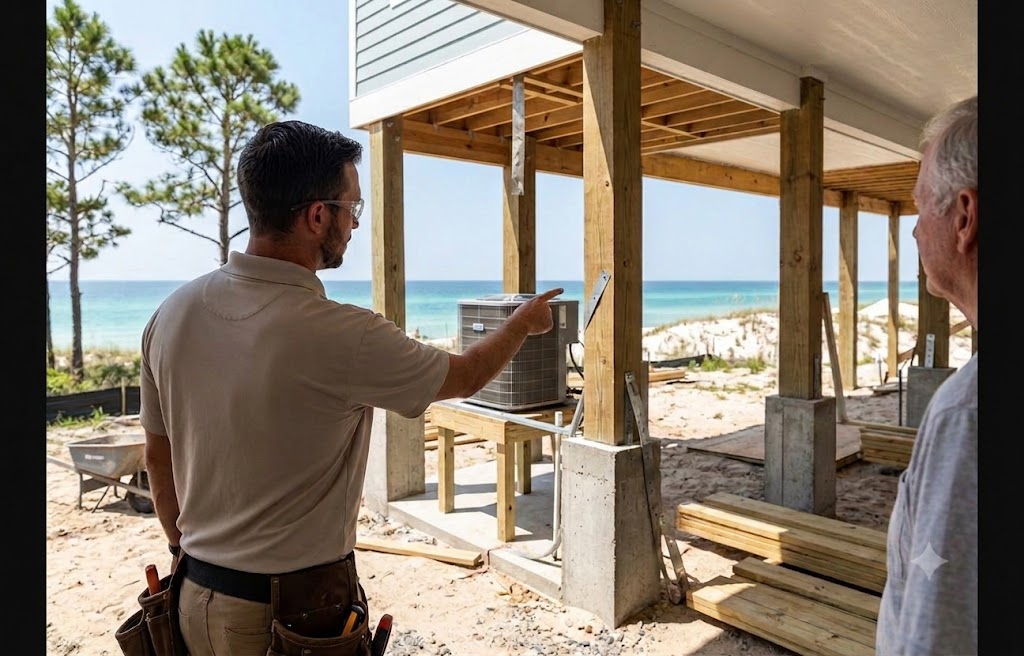
Salt air does real work on a house here, and a good coastal inspector knows to look for it. Metal fasteners, HVAC condenser coils, and exterior hardware corrode faster a quarter mile from the water than they do inland, so do not be surprised to see notes on AC unit condition or window and door hardware. These are usually smaller-dollar items, good candidates for a modest credit rather than a dealbreaker.
On an elevated home, the pilings and foundation get real scrutiny. Most homes on Cape San Blas, Indian Pass, and the beachfront stretches of Mexico Beach and St. George Island sit on pilings, which is exactly what building codes in flood-prone zones require so wave energy can pass beneath the structure instead of pushing against it. A thorough inspector checks those pilings and any reinforced foundation elements for cracking or movement. Most of what turns up is cosmetic or age-appropriate wear, but if something structural comes back, that is worth a specialist's opinion before you decide how to proceed, and it is squarely the kind of finding a credit or price adjustment should reflect.
A WDO report is standard practice on nearly every Florida sale, mine included, and it typically runs $150 to $300. If it shows active termite activity, treatment cost is usually the seller's responsibility to negotiate, often landing in the $600 to $3,000 range depending on scope. Old, already-treated damage is a different conversation and is much more negotiable as a credit item than a dealbreaker.
If you want the fuller picture on the financial side of getting to the closing table, my breakdown of wind insurance on a Forgotten Coast beach home goes deeper into how roof age and wind mitigation credits affect your premium once you own the place, and my guide on property taxes on a vacation home here covers another cost worth understanding before you finalize your budget.
Why this market gives you more room right now
The negotiating climate has genuinely shifted in your favor. Inventory has been climbing across Cape San Blas and the surrounding coast for weeks now, and sellers who have had a listing sit for a while are far more willing to work with a reasonable inspection request than they were during the frenzy of a few years back. A well-supported, focused ask is landing more often than it used to, and that trend has been building all year. If you want the bigger picture on how today's market favors buyers on price, terms, and timing, I laid that out in my post on whether now is a good time to buy on the Forgotten Coast. An inspection credit is really just one more place that leverage shows up.
None of this means every finding is worth fighting over, and it does not mean you should nickel-and-dime a seller over a loose cabinet hinge. It means you get to be strategic. Decide what genuinely matters to the home's safety, structure, or insurability, put a number on it with a real contractor estimate, and make your ask before the inspection deadline closes that door. Whatever the seller agrees to, get it in writing in a signed addendum before you release your inspection contingency. A verbal "sure, we'll take care of it" is not worth the paper it is not written on.
Frequently Asked Questions
Can I force a seller to fix things after a Florida home inspection?
Not under the standard AS IS contract used across the Forgotten Coast. The seller is not required to make repairs. What you do have is the right to cancel the contract and get your deposit back within the inspection period, which is exactly what gives you leverage to negotiate a credit, a price reduction, or seller-completed repairs instead.
Should I ask for a repair or a closing credit?
In most cases, a credit serves you better. You control the contractor, the quality, and the timeline, and you are not relying on the seller to complete work to your standards before closing. Save the repair request for something simple and quick to verify, like an active pest treatment.
How long do I have to negotiate after my inspection on the Forgotten Coast?
Most contracts here use a 10 to 15 day inspection period from the date the contract is fully signed, and the clock includes weekends and holidays. This is a hard deadline. Get your inspection scheduled early in that window so you have real time left to negotiate before it closes.
Is an older roof a dealbreaker on a coastal Florida home?
Not necessarily. Florida law prevents an insurer from declining coverage solely because a roof is under 15 years old, and even past that mark, a licensed inspector's certification of five or more years of remaining life keeps that protection in place. An aging roof is usually a negotiating point, worth a credit toward inspection or eventual replacement, rather than a reason to walk away from a home you love.
What inspection issues are specific to elevated Gulf Coast homes?
Salt air accelerates corrosion on metal fasteners, HVAC components, and exterior hardware faster here than inland, and a good inspector on Cape San Blas or Indian Pass will also look closely at pilings and any reinforced foundation elements for cracking or shifting. Most findings are cosmetic or age-appropriate, but any structural note is worth a specialist's second opinion before you decide how to move forward.
Here is the bottom line: your inspection report is not bad news, it is information, and in today's Forgotten Coast market it is information you can use. Focus your request on what genuinely matters, back it up with a real number, and let the seller's incentive to keep a solid buyer carry the negotiation. I walk every one of my buyers through this exact process, from reading the report line by line to deciding what is worth asking for and what to let go. If you are staring at an inspection report right now on a home in Cape San Blas, Port St. Joe, Mexico Beach, or St. George Island, call or text me and let's figure out your best move together.
Billy Joe Smiley is one of Florida's most accomplished real estate professionals, with over 27 years of experience and more than 1,000 properties sold. As a top 1% REALTOR® based at Port Realty Group, Billy Joe serves the Forgotten Coast with unmatched insight, professionalism, and care. He works with buyers and sellers across Port St. Joe, Cape San Blas, Mexico Beach, and St. George Island, specializing in luxury and waterfront homes, investment properties and 1031 exchanges, beachfront and bayfront land, vacation homes and income-producing real estate, and real estate development and architectural planning. A Gulf County native, Billy Joe pairs deep local knowledge with decades of experience in brokerage, land development, custom home building, and architectural consulting. Recognized as The Forgotten Coast's Most Trusted Realtor, Billy Joe has earned 90+ public reviews across Zillow, Google, and Realtor.com.
Enjoy this blog post? Click here to subscribe for updates
Leave A Comment