
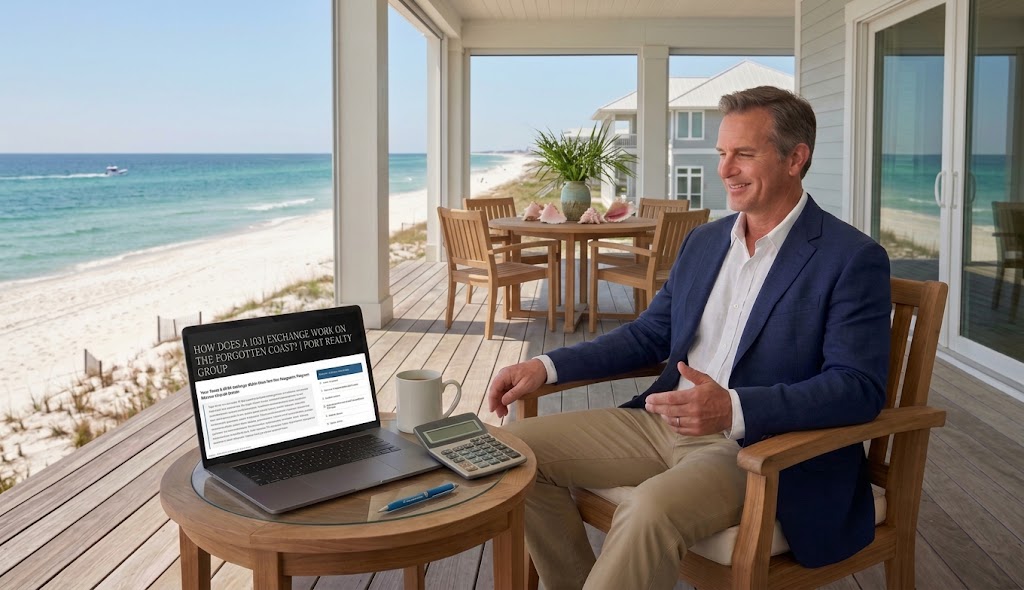
How Does a 1031 Exchange Work When You Sell Investment Property on the Forgotten Coast?
A 1031 exchange lets you sell a qualifying investment or rental property and roll the proceeds into your next one without paying federal capital gains tax right now. You defer the gain instead of losing a chunk of it, as long as you use a qualified intermediary, identify a replacement property within 45 days, and close within 180. Florida has no state capital gains tax to worry about, but documentary stamp tax still applies on both sides of the exchange. Get the timeline and the paperwork right, and this is one of the most valuable tools an investor on this coast has for building real wealth over time.
By Billy Joe Smiley | August 13, 2026
If you own a rental home on Cape San Blas or Port St. Joe and you're thinking about selling, there's a good chance the number that worries you most isn't your sale price. It's the tax bill that shows up after. I hear this question constantly from investors whose rentals have appreciated nicely and who now want to trade up or reposition. The good news is you have an excellent tool for this, one I've used to structure deals for clients for years.
A 1031 exchange, named for the section of the tax code that creates it, lets you sell an investment property and buy another one without triggering the federal capital gains tax you'd otherwise owe at closing. You're deferring the tax, not avoiding it, and rolling your full equity forward into the next property instead of watching the IRS take a slice off the top. Done right, it's one of the smartest moves an investor on this coast can make.
What actually qualifies, and the good news for vacation rental owners
The core rule is simple: both the property you sell and the property you buy have to be held for investment or business use, not personal enjoyment. A primary residence doesn't qualify. But here's what a lot of owners on this coast don't realize: a vacation rental you also enjoy personally can still qualify, as long as you meet the IRS safe harbor.
Under Revenue Procedure 2008-16, your rental property qualifies as investment property for a 1031 exchange if you've owned it at least 24 months and, in each of those two years, you rented it at fair market rate for at least 14 days while keeping your own personal use to the greater of 14 days or 10% of the days it was rented. If your gulf-view rental on Mexico Beach or St. George Island has been performing as a short-term rental for a couple of seasons, chances are good it already clears this bar. That's genuinely great news, because it means the STR income you've been collecting is also building your case to defer tax on the sale.
The "like-kind" requirement people worry about is broader than most expect, too. You don't have to trade a beach house for another beach house. Any real property held for investment or business use can generally exchange for any other, whether that's a bayfront lot, a duplex, or a commercial building. Your options for where to put your equity next are wider than you might think.
The 45 and 180 day clock, and why planning ahead makes this easy
Here's the part that actually matters most for how we plan your sale. Once your relinquished property closes, you have 45 calendar days to identify your replacement property or properties in writing, and 180 calendar days total from that same closing date to close on one of them. That's not 45 days plus 180 days. It's 180 days total, with the identification deadline sitting inside it.
These deadlines are firm. They don't move for weekends or holidays, and there's no extension available outside of a formal IRS disaster postponement. That sounds intimidating, but it's genuinely manageable when you plan for it before you list rather than after. You can identify up to three potential replacement properties of any value, or more than three as long as their combined value stays under 200% of what you sold. In practice, that means we start looking at replacement options while your current property is still under contract, not after it closes, so the 45-day window works in your favor instead of against you.
A qualified intermediary, often called a QI, is required by law to hold your sale proceeds during this window. You're not allowed to touch the money yourself, even briefly, or the exchange falls apart. When you're choosing a QI, look for one with a segregated, FDIC-insured account for your funds, a solid track record, and ideally accreditation through the Federation of Exchange Accommodators. This is not the place to shop on price alone. I work with a small group of QIs I trust for exactly this reason, and I'm glad to make an introduction when the time comes.
For the fuller picture on what you'll net from your current property before you roll it into the next one, my breakdown of property taxes on a vacation home on the Forgotten Coast is a useful companion piece, since your new property's tax basis and assessment will factor into your long-term numbers.
What still gets taxed here in Florida, and why that's a small price to pay
Florida makes this easier than most states because we don't have a state income tax, so a 1031 exchange here only has to deal with the federal capital gains piece. That said, one Florida-specific cost doesn't get deferred: documentary stamp tax. Doc stamps, currently $0.70 per $100 of consideration in Gulf County and most of Florida, apply to the deed transfer on both the property you sell and the property you buy, even inside an exchange. It's worth budgeting for as a real transaction cost, but it's a modest one compared to the capital gains tax you're deferring, often tens or even hundreds of thousands of dollars depending on your property's appreciation.
Investment properties also don't qualify for the primary-residence capital gains exclusion that lets homeowners shelter up to $250,000, or $500,000 for a married couple, in gains tax-free. That's exactly why the 1031 exchange matters so much if your rental has appreciated well. Without it, that whole gain is exposed the year you sell. With it, you keep your full equity working for you in the next property.
Why this coast is a strong place to put your exchange to work right now
The timing lines up well for investors this year. Inventory has been climbing across Cape San Blas and the surrounding coast, which means more selection and more negotiating room when you're identifying a replacement property within that 45-day window. Short-term rental performance in this market has stayed strong, with Port St. Joe area rentals running solid occupancy and daily rates that make the reinvestment case an easy one to build. If you've owned a performing rental here for a couple of seasons and you're ready to trade into something bigger, better positioned, or simply different, this is a very good moment to have that conversation.
A 1031 exchange rewards preparation. The investors who get the smoothest results are the ones who start planning their replacement property search before their current listing even goes live, line up their qualified intermediary early, and know their numbers cold going in. That's exactly the kind of planning I do with clients well before we ever put a sign in the yard.
Frequently Asked Questions
Can I do a 1031 exchange on my Cape San Blas vacation rental?
Yes, if it meets the IRS safe harbor under Revenue Procedure 2008-16: owned at least 24 months, rented at fair market rate at least 14 days in each of those two years, with your personal use capped at the greater of 14 days or 10% of the rented days. Most performing short-term rentals on this coast that have been operating for a couple of seasons already meet this standard.
What is a qualified intermediary and do I really need one?
Yes, it's required by law. A qualified intermediary is an independent third party who holds your sale proceeds between closing on your old property and closing on your new one. You can never take actual or constructive receipt of the money yourself, so choosing a QI with a strong track record and a segregated, FDIC-insured account matters a great deal.
Do I have to buy a similar type of property to qualify?
No. The like-kind requirement for real estate is broad. Any real property held for investment or business use generally qualifies as like-kind to any other, so a beach rental can exchange into a duplex, a bayfront lot, or a different property type entirely, as long as both sides are held for investment purposes.
What happens if I miss the 45-day identification deadline?
The exchange fails and the sale is treated as a regular taxable transaction. This is exactly why planning ahead matters. Starting your replacement property search before your current listing closes, rather than after, keeps that 45-day window comfortable instead of stressful.
Does a 1031 exchange get me out of paying Florida doc stamps?
No, and that's a good detail to budget for going in. Florida's documentary stamp tax, $0.70 per $100 of consideration in Gulf County and most of the state, applies to the deed transfer on both properties in the exchange. It's a modest cost compared to the federal capital gains tax you're deferring, which is often a far larger number.
A 1031 exchange takes a little more coordination than a straightforward sale, but it's one of the most valuable tools available to investors on this coast, and it rewards the people who plan ahead. If you own a rental on Cape San Blas, Port St. Joe, Mexico Beach, or St. George Island and you're weighing whether now is the time to sell and roll into your next property, let's talk through your specific timeline and numbers before you list. I've helped clients structure exactly this kind of move for years, and getting the plan right from day one makes the whole process feel a lot less like a scramble and a lot more like a strategy. Call or text me and let's map it out together.
Billy Joe Smiley is one of Florida's most accomplished real estate professionals, with over 27 years of experience and more than 1,000 properties sold. As a top 1% REALTOR® based at Port Realty Group, Billy Joe serves the Forgotten Coast with unmatched insight, professionalism, and care. He works with buyers and sellers across Port St. Joe, Cape San Blas, Mexico Beach, and St. George Island, specializing in luxury and waterfront homes, investment properties and 1031 exchanges, beachfront and bayfront land, vacation homes and income-producing real estate, and real estate development and architectural planning. A Gulf County native, Billy Joe pairs deep local knowledge with decades of experience in brokerage, land development, custom home building, and architectural consulting. Recognized as The Forgotten Coast's Most Trusted Realtor, Billy Joe has earned 90+ public reviews across Zillow, Google, and Realtor.com.
Enjoy this blog post? Click here to subscribe for updates
Leave A Comment