
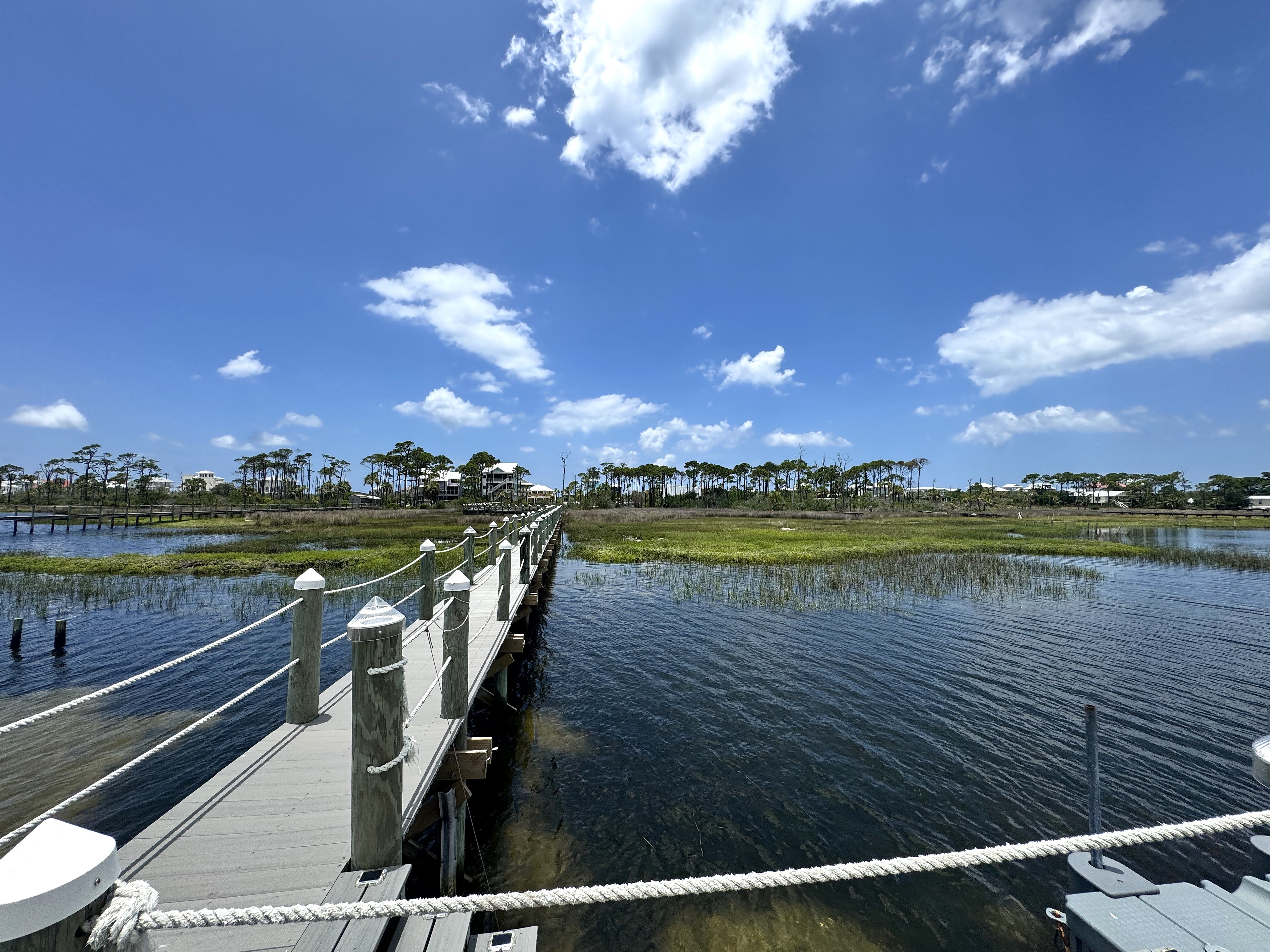
Can I build a dock or boat lift on my Forgotten Coast waterfront property?
In most cases, yes, but the answer depends on where the lot sits and what's under the water in front of it. Bay-front and canal-front lots on the Forgotten Coast typically qualify for a straightforward state exemption or a simple general permit, while lots on St. Joseph Bay near protected seagrass beds may need extra design steps and a submerged land lease from the state. None of this should scare you off a waterfront purchase. It just means dock rights are a due-diligence item to confirm before you write an offer, not something to assume.
By Billy Joe Smiley | Published July 28, 2026
I get this question more than almost any other from buyers looking at bay-front and canal lots on the Forgotten Coast: "If I buy this place, can I put a boat lift out back?" It's a fair thing to want answered before you're under contract, because for a lot of my clients, the dock is half the reason they're buying waterfront in the first place. The good news is that most residential dock and boat lift projects on Port St. Joe's bay side, in the Mexico Beach canals, and along the Apalachicola River move through the process without much drama. There's just a specific path to follow, and knowing it ahead of time turns a question mark into a checklist.
Florida treats the water in front of your property differently than the land your house sits on. The state owns the submerged bottomland below the mean high water line, so building anything out over it, a dock, a lift, a boathouse, requires permission from the state even though you own the upland lot. That's true whether you're on a quiet canal in Mexico Beach or looking at open bay frontage on Cape San Blas. The permission usually comes in one of two forms: either your project is small enough to qualify for an exemption or a general permit, or it needs an individual review and a submerged land lease. Most single-family docks fall into the first category.
The exemption path: what covers most residential docks
Florida's Department of Environmental Protection allows private docks up to 1,000 square feet of surface area over state waters to qualify for an exemption from a full individual permit, and that threshold drops to 500 square feet if the water is designated an Outstanding Florida Water. A typical residential dock with a boat lift for one or two boats comes in well under those limits, which is why so many of these projects move quickly. The exemption route still usually requires a Consent of Use to authorize the structure sitting on state-owned bottomland, and depending on your site, a self-certification or an Exemption Verification review from FDEP. Fee-wise, that verification review currently runs around $100, and a general permit review, for projects that don't qualify for the exemption but aren't large enough to need a full individual permit, runs around $250. Those are the state review fees. Actual construction cost is a separate number, and it varies a lot depending on materials and site conditions: a simple dock on protected water might land well under $20,000, while a piling-built dock with a boat lift on more exposed water can run $100,000 or more. I always tell buyers to get a firm quote from a licensed local dock builder once they know their site, rather than anchoring to a national average.
One thing that surprises out-of-state buyers: even when the state exempts your dock from a full permit, the county or your community's covenants may still have their own requirements. It's worth a quick call to Gulf County's building department, or Franklin County's if you're looking on St. George Island or Eastpoint, to confirm there isn't a separate local building permit needed for the dock or the lift's electrical work. This is a five-minute phone call that saves a lot of back-and-forth later.
St. Joseph Bay is a special case, and it's worth understanding before you shop that shoreline
If you're looking at bay-front property on Cape San Blas or the Port St. Joe side of St. Joseph Bay, there's a detail worth knowing early. St. Joseph Bay is a designated Aquatic Preserve, protected in large part because its seagrass meadows, covering roughly a sixth of the bay bottom, serve as nursery habitat for the fish and shellfish this whole stretch of coast is known for. That protection is a genuine asset for the area's fishing and water quality, and it's also why dock construction rules here are a notch more detailed than on an ordinary canal.
For a single-family dock built over or near seagrass in an Aquatic Preserve, the state's technical guidance calls for at least one foot of clearance between the top of the grass and the lowest point of a boat moored at the dock, so props and hulls don't scar the bottom. Decking is specified too: boards no wider than eight inches with at least a half-inch gap between them, so enough sunlight reaches the grass below. And any section of dock over seagrass needs to sit at least five feet above the mean high water line. None of this rules out a dock on bay-front St. Joseph Bay property. It just means the design has a bit more engineering built in, and it's a good reason to walk the shoreline at low tide with your agent or a local dock contractor before you finalize an offer, so you can see exactly where the grass beds sit relative to where you'd want to build.
If a project doesn't qualify for the exemption, either because of its size or its location over sensitive habitat, it moves into the Consent of Use or submerged land lease process under Florida law. That review takes longer than an exemption, often stretching from a few weeks for straightforward sites to a few months when seagrass, water depth, or neighboring dock spacing needs a closer look. I'd rather tell a buyer that up front than have them assume a lift will be installed the week after closing.
How to build this into your due diligence, not your dream
The smart move is to treat dock rights the same way you'd treat a survey or a home inspection: something you confirm during your due diligence period, not something you assume from the listing photos. Before you write an offer on a waterfront lot, ask a few direct questions. Is there an existing dock, and if so, was it permitted, and can the seller produce that permit or a record of the exemption? If there's no dock yet, has anyone checked water depth at the proposed dock location at low tide, since depth affects both what's buildable and what kind of boat the spot can actually accommodate? And is the parcel inside the St. Joseph Bay Aquatic Preserve boundary, where the seagrass-specific design rules apply?
Once you're under contract, this is the point to call a licensed local dock builder or marine contractor for a site visit. They deal with FDEP's exemption and Consent of Use process regularly and can generally tell you within a conversation or two whether your project is a straightforward exemption, a general permit situation, or something that needs a fuller review. That conversation costs you nothing but a phone call, and it turns "I hope I can put a dock here" into "here's exactly what it'll take and what it'll cost." If insurance comes up as part of your broader due diligence on a waterfront purchase, that's worth a separate conversation with your agent about wind and flood coverage rather than folding it into your pre-offer dock checklist. Keep the two tracks distinct and neither one becomes overwhelming.
I've watched buyers get this exactly right by simply asking early. A family looking at a canal lot in Mexico Beach called their dock contractor the same week they went under contract, had a design sketch and a rough cost within ten days, and closed knowing precisely what they'd be building that fall. That's the version of this process I want for every waterfront buyer I work with here, whether you're eyeing Mexico Beach canal frontage, bay-front acreage on Cape San Blas, or a quiet stretch along the Apalachicola River.
If you're weighing a waterfront lot right now and want a straight read on what its dock situation actually looks like, that's exactly the kind of question I like getting a call about before an offer goes in, not after.
Frequently Asked Questions
Do I need a permit for a dock on the Forgotten Coast, or does owning waterfront property include automatic dock rights?
Owning waterfront land doesn't automatically include the right to build over the water in front of it. Florida owns the submerged bottomland below the mean high water line, so any dock or lift needs state authorization, most often through a straightforward exemption or general permit for typical residential-sized projects.
How much does it cost to build a dock and boat lift near Cape San Blas or St. George Island?
State review fees are modest, generally around $100 for an exemption verification and around $250 for a general permit. Construction cost is the bigger number and depends heavily on materials, water depth, and site conditions, ranging from well under $20,000 for a simple dock on protected water up to $100,000 or more for a piling-built dock with a boat lift on more exposed water. A local dock contractor can give you a firm site-specific quote.
Why are dock rules different on St. Joseph Bay than on a Mexico Beach canal?
St. Joseph Bay is a designated Aquatic Preserve because of its extensive seagrass meadows, which support the area's fisheries. Docks built over or near seagrass there follow additional design specifications, including clearance above the grass, spaced decking to let light through, and minimum height requirements, that don't apply to a standard canal dock outside a preserve boundary.
How long does it take to get a dock permit approved?
Straightforward residential docks that qualify for an exemption or general permit can often move through in a matter of weeks. Projects near seagrass, in deeper water, or that need an individual review and a submerged land lease can take a few months. Getting a local contractor's read on your specific site early gives you a realistic timeline rather than a guess.
Should I confirm dock rights before or after I make an offer?
Before, if possible, and always during your due diligence period at the latest. A quick call to a local dock builder or marine contractor once you have a specific address can usually tell you whether the project is a simple exemption or something that needs more review, so you know exactly what you're working with before you're committed.
If you're looking at bay-front, canal-front, or river-front property anywhere from St. Joe Beach to St. George Island and want to know exactly what a dock or boat lift would take on a specific lot, give me a call or send a text. I've spent 27 years on this stretch of coast and I'm happy to walk you through it before you ever write an offer.
About Billy Joe Smiley: Billy Joe Smiley is one of Florida's most accomplished real estate professionals, with over 27 years of experience and more than 1,000 properties sold. As a top 1% REALTOR® based at Port Realty Group, Billy Joe serves the Forgotten Coast with unmatched insight, professionalism, and care. He works with buyers and sellers across Port St. Joe, Cape San Blas, Mexico Beach, and St. George Island, specializing in luxury and waterfront homes, investment properties and 1031 exchanges, beachfront and bayfront land, vacation homes and income-producing real estate, and real estate development and architectural planning. A Gulf County native, Billy Joe pairs deep local knowledge with decades of experience in brokerage, land development, custom home building, and architectural consulting. Recognized as The Forgotten Coast's Most Trusted Realtor, Billy Joe has earned 90+ public reviews across Zillow, Google, and Realtor.com. Learn more about Billy Joe.
Enjoy this blog post? Click here to subscribe for updates
Leave A Comment